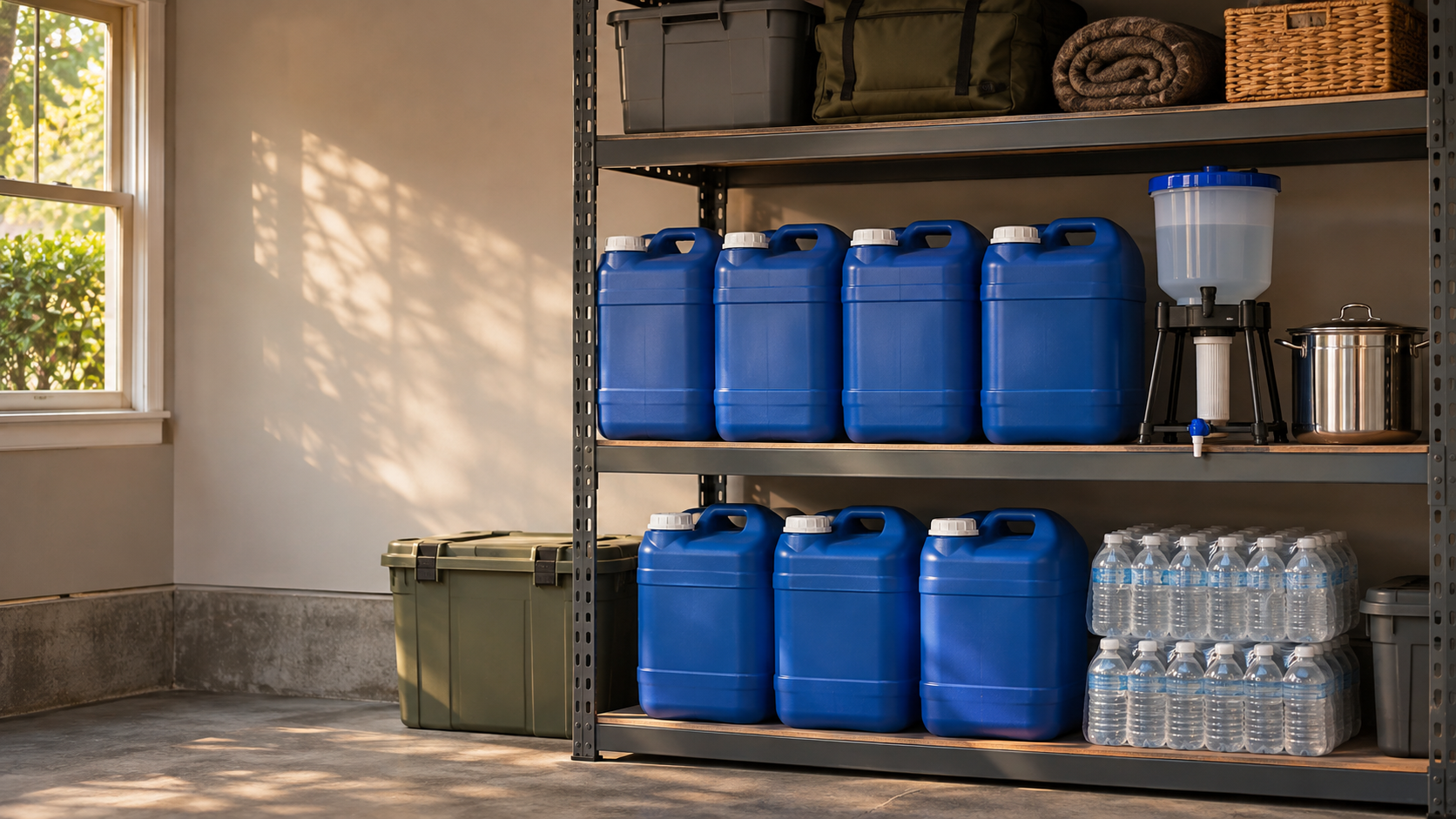
Emergency Water Storage & Purification: A Beginner's Guide
Emergency Water Storage & Purification: A Practical Guide for Everyday Americans
How to prepare your family for power outages, natural disasters, and extended grid-down emergencies.
Affiliate Disclosure: As an Amazon Associate, Freedom Gear Co. earns from qualifying purchases. Some links in this article may earn us a commission at no additional cost to you.
There's a growing concern among Americans about the reliability of our nation's electrical grid.
Between natural disasters, aging infrastructure, cyberattack threats, and increasing uncertainty about the future, more people are asking a question they may never have seriously considered before:
What would happen if the power went out and didn't come back on for days, weeks, or even longer?
It's an uncomfortable question, but it's one worth asking.
When most people think about emergency preparedness, their minds immediately go to food, generators, batteries, and survival equipment.
But there's something far more important that often gets overlooked.
Water.
You can survive considerably longer without food than without water. A pantry full of canned goods won't do you much good if you have nothing safe to drink.
The good news is that preparing an emergency water supply doesn't have to be complicated or expensive.
You simply need to understand three things:
How much water your family needs.
How to store drinking water safely.
How to purify additional water when your supply runs low.
Let's walk through each one.
If you're new to emergency preparedness, start with our Beginner's Guide to Preparedness.
And if you're concerned about extended electrical outages, read How to Prepare Your Home for a Power Outage.
1. How Much Emergency Water Should You Store?
The Centers for Disease Control and Prevention (CDC) recommends storing at least one gallon of water per person, per day, with enough water for a minimum of three days.
If possible, the CDC recommends working toward a two-week supply.
That one gallon covers basic needs such as drinking, preparing food, and limited personal hygiene.
However, your family may need more depending on:
Climate and temperature
Physical activity
Medical conditions
Pregnancy
Pets
Additional sanitation needs
Here's how much water an average household should consider storing.
People | 3 Days | 7 Days | 14 Days |
|---|---|---|---|
1 | 3 gallons | 7 gallons | 14 gallons |
2 | 6 gallons | 14 gallons | 28 gallons |
3 | 9 gallons | 21 gallons | 42 gallons |
4 | 12 gallons | 28 gallons | 56 gallons |
5 | 15 gallons | 35 gallons | 70 gallons |
These are minimum quantities, not necessarily enough for normal household consumption.
For a family of four, a two-week emergency water supply requires at least 56 gallons.
That might sound overwhelming, but building this supply gradually is entirely manageable.
Freedom Gear Tip: Start with a three-day supply, expand to seven days, and work toward two weeks. Preparedness is a process, not something you have to accomplish overnight.
For additional planning, see our Emergency Food and Water Storage Guide.
You can also use our 72-Hour Emergency Kit Guide to prepare for shorter disruptions.
2. The Best Ways to Store Emergency Drinking Water
You don't need a massive underground tank or an expensive survival system to get started.
For most households, a combination of commercially bottled water and reusable food-grade water containers is a practical approach.
Commercially Bottled Water
Perhaps the easiest way to begin is purchasing extra cases of bottled drinking water.
Commercially bottled water is convenient, requires very little preparation, and is relatively easy to store.
You can gradually build your emergency supply by purchasing a few extra cases during regular grocery trips.
However, bottled water has disadvantages.
Individual bottles take up considerable space and aren't always convenient when larger amounts of water are needed.
That's where dedicated water-storage containers become useful.
Food-Grade Water Storage Containers
For household emergency preparedness, reusable food-grade containers are an excellent investment.
Common sizes include:
5-gallon portable containers
7-gallon water jugs
15-gallon storage containers
55-gallon water drums
For the average homeowner, five-gallon containers are particularly practical.
They're portable, relatively easy to store, and allow you to distribute your water supply throughout your home.
Five gallons of water weighs approximately 42 pounds, plus the container.
Larger containers provide greater capacity but become considerably more difficult to move.
Recommended Emergency Water Storage Gear
Shop 5-Gallon Food-Grade Water Containers on Amazon
Shop Stackable Emergency Water Containers on Amazon
Shop 55-Gallon Water Storage Drums on Amazon
When purchasing containers, make sure they're specifically designed for potable drinking water.
Never use containers that previously held fuel, chemicals, pesticides, or other hazardous substances.
3. How to Store Drinking Water Safely
Buying the proper containers is only the beginning.
How you store your emergency drinking water is just as important.
According to CDC guidance, water-storage containers should be cleaned and sanitized before filling.
Once filled, follow these recommendations.
Store Water in a Cool, Dark Location
Keep your water away from direct sunlight and excessive heat.
The CDC recommends storage temperatures between 50°F and 70°F when possible.
Keep Containers Sealed
Use containers with tight-fitting lids to prevent dirt, insects, and other contaminants from entering.
Avoid Chemical Storage Areas
Never store drinking water next to gasoline, pesticides, solvents, or other hazardous materials.
Label Your Containers
Write the filling date on each container.
This makes it easier to maintain a regular rotation schedule.
Rotate Your Water Supply
The CDC recommends replacing water you've filled into storage containers every six months.
For commercially bottled water, follow the manufacturer's storage instructions and expiration dates.
Freedom Gear Tip: A 55-gallon drum contains approximately 459 pounds of water when full. Make sure the storage location can safely support the weight.
4. What Happens When Your Stored Water Runs Out?
Here's where emergency preparedness becomes particularly important.
Storing water is your first line of defense.
But what happens if an emergency lasts longer than expected?
Imagine an extended power outage.
Your family's emergency water supply is running low, stores are closed, and your local water system isn't functioning.
Where will your next gallon of safe drinking water come from?
Depending on your location, potential emergency water sources could include:
Rainwater
Freshwater streams
Lakes
Ponds
Other available freshwater sources
However, there's something everyone needs to understand.
Just because water looks clean doesn't mean it's safe to drink.
Clear water can contain dangerous bacteria, viruses, parasites, and chemical contaminants.
Drinking contaminated water can cause serious illness, particularly when access to medical care is limited.
Knowing how to treat water is one of the most valuable preparedness skills you can develop.
For additional skills worth learning, read our Top 10 Preparedness Skills Every Man Should Learn.
5. Water Filtration vs. Water Purification: What's the Difference?
These terms are frequently used interchangeably, but they don't necessarily mean the same thing.
Understanding the difference can prevent you from purchasing equipment that doesn't meet your needs.
Water Filtration
Water filtration uses a physical barrier or other filtration media to remove certain contaminants.
Depending on the equipment, a filter may remove:
Dirt and sediment
Certain bacteria
Parasites
Some chemicals
Unpleasant tastes and odors
However, not all filters remove the same contaminants.
Many portable camping filters remove bacteria and parasites but cannot reliably remove viruses.
Water Purification
Water purification involves treatment intended to make water microbiologically safe, including addressing viruses, bacteria, and parasites.
Treatment methods include boiling, chemical disinfection, and specialized purification equipment.
But there's an important limitation.
Neither boiling nor ordinary chemical disinfection reliably removes fuel, salts, heavy metals, or many toxic chemicals.
If you suspect chemical contamination, use a different water source and follow local health department instructions.
Never assume that any single filtration or purification method can make every water source safe.
6. Best Emergency Water Purification Methods Without Electricity
One of the most useful pieces of preparedness equipment is a water treatment system that doesn't require electricity.
During a prolonged grid-down emergency, relying entirely on electrical equipment could leave you without access to safe drinking water.
There are several options worth considering.
Gravity-Fed Water Filters
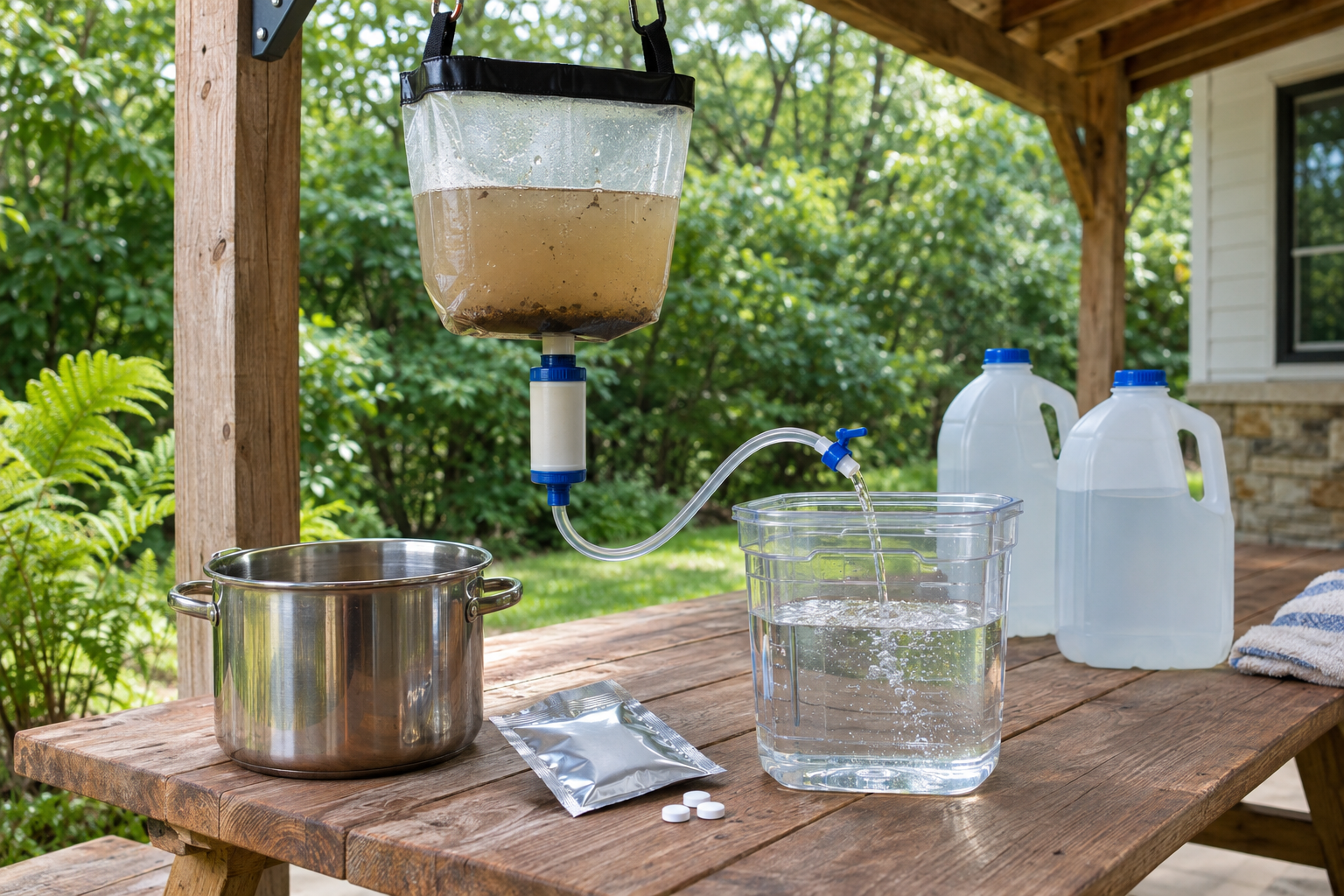
Gravity-fed water filters use gravity to move water through a filtration system.
They generally require no electrical power or complicated installation.
For families, larger gravity-fed systems offer some advantages over small personal filters.
They allow you to filter more water at one time and can be convenient for everyday emergency use.
However, filtration performance varies considerably.
Some systems remove bacteria and parasites but not viruses.
Before purchasing, verify exactly what the manufacturer has tested the system to remove.
Recommended Gear:
Shop Gravity-Fed Water Filtration Systems on Amazon
Portable Water Filters
Portable water filters are another useful option.
These lightweight devices are commonly used by hikers, campers, and preparedness enthusiasts.
Manufacturers such as Sawyer and LifeStraw offer compact filtration products designed for outdoor use.
A portable filter can be especially useful for:
Emergency evacuation
Camping
Hiking
Bug out bags
Backup household filtration
However, remember that many portable filters do not remove viruses.
They should be used according to their tested capabilities and the manufacturer's instructions.
Recommended Gear:
Shop Sawyer Portable Water Filters on Amazon
Shop LifeStraw Water Filters on Amazon
For additional portable survival equipment, see our Outdoor Survival Essentials Guide.
Boiling Water
Boiling is one of the simplest and most reliable methods for killing disease-causing microorganisms in drinking water.
The CDC recommends bringing clear water to a rolling boil for one minute.
At elevations above 6,500 feet, boil for three minutes.
If water is cloudy, allow sediment to settle or filter it through a clean cloth or coffee filter before boiling.
After boiling, let the water cool and transfer it to a sanitized container with a tight-fitting lid.
The disadvantage is that boiling requires a reliable heat source.
During a power outage, this might include an appropriate propane stove or other emergency cooking equipment.
Never operate outdoor camping stoves, grills, or generators inside your home or garage. Carbon monoxide can be deadly.
Remember that boiling does not reliably remove chemical contaminants.
Water Purification Tablets
Water purification tablets are another useful addition to an emergency preparedness kit.
They're lightweight, compact, and easy to store.
Chlorine dioxide tablets are one common option.
However, treatment times and effectiveness vary by product and contaminant.
Some microorganisms require extended treatment times, and certain chemical disinfectants are ineffective against particular parasites.
Always follow the manufacturer's instructions.
Recommended Gear:
Shop Chlorine Dioxide Water Purification Tablets on Amazon
7. Can Household Bleach Make Water Safe to Drink?
Yes, under appropriate circumstances.
Regular unscented household chlorine bleach can be used to disinfect drinking water during emergencies.
However, the correct amount depends on the bleach's sodium hypochlorite concentration.
According to CDC guidance, when using regular unscented bleach containing 5%–9% sodium hypochlorite:
Water Quantity | Bleach Amount |
|---|---|
1 gallon | 8 drops |
5 gallons | 40 drops |
These amounts are for clear water.
Mix thoroughly and allow the treated water to stand for at least 30 minutes.
If water is cloudy, colored, or very cold, CDC guidance calls for additional treatment precautions.
Never use scented bleach, color-safe bleach, or products containing added cleaners.
Bleach is also less effective against some parasites than boiling, and it does not remove toxic chemicals.
For complete emergency water disinfection instructions, visit the CDC's official water safety guide.
8. Can You Drink Collected Rainwater?
Rainwater collection is another option worth considering, particularly for people concerned about extended off-grid living.
A rainwater collection system may provide additional water for certain household needs.
However, there's an important misconception about rainwater.
Rainwater isn't automatically safe to drink.
Water collected from a roof can contain:
Bird droppings
Bacteria
Parasites
Roofing chemicals
Environmental pollutants
Collected rainwater should be evaluated and appropriately treated before drinking.
Even then, ordinary filtration or disinfection may not address every potential contaminant.
Rainwater collection is best viewed as an additional water source rather than a replacement for safely stored drinking water.
Recommended Gear:
Shop Rainwater Collection Barrels on Amazon
9. Building Your First Emergency Water Preparedness Kit
If you're new to preparedness, there's no reason to become overwhelmed.
You don't need to purchase every piece of survival equipment available.
Start with the basics and build your system gradually.
For an average family of four, here's a practical starting point.
Equipment | Purpose |
|---|---|
28 gallons of stored water | Seven-day minimum supply |
Food-grade storage containers | Safe water storage |
Gravity-fed water filter | Household filtration |
Portable water filter | Backup and evacuation use |
Water purification tablets | Emergency disinfection |
Stainless-steel cooking pot | Boiling water |
Safe emergency cooking equipment | Heating water without electricity |
Sanitized containers | Storing treated water |
Remember that 28 gallons represents a seven-day supply at the minimum recommended amount.
A two-week supply for four people would require at least 56 gallons.
And you may need additional water for pets, hygiene, medical needs, and sanitation.
One final recommendation:
Learn how to use your equipment before an emergency happens.
Read the instructions.
Practice assembling your filtration equipment.
Understand its limitations.
Know how to safely store treated water.
A water filter sitting unopened in its original packaging isn't nearly as useful as one you already know how to operate.
For more help building your household emergency supplies, read our Beginner Emergency Preparedness Kit Guide.
10. Emergency Preparedness Isn't About Fear
Let's be clear about something.
Nobody knows whether the United States will experience a prolonged nationwide electrical grid failure.
And anyone claiming to know exactly when such an event will occur should be viewed with skepticism.
But we don't have to predict a nationwide catastrophe to recognize the importance of preparedness.
Hurricanes happen.
Floods happen.
Water mains break.
Severe storms damage electrical infrastructure.
Municipal water systems experience unexpected disruptions.
These things already occur, sometimes with very little warning.
The question isn't whether a dramatic national disaster is coming.
The question is whether your family could manage if the water stopped flowing tomorrow.
Would you have enough drinking water?
Could you safely treat additional water?
Would you know what equipment to use?
If the answer is no, there's no reason to panic.
There's simply a reason to prepare.
At Freedom Gear Co., we believe preparedness begins with taking responsibility for yourself and those who depend on you.
It isn't about living in fear of what might happen tomorrow.
It's about having the knowledge, equipment, and confidence to handle unexpected situations.
Whether you live in a rural community, suburban neighborhood, or major city, basic emergency preparedness is something everyone should take seriously.
If you live in an apartment or densely populated area, our Urban Survival Guide provides additional recommendations for limited-space preparedness.
Start with water. Start with the basics. And start before you need them.
Because when an emergency happens, the best time to prepare has already passed.
Frequently Asked Questions About Emergency Water Storage
How much water should I store for an emergency?
The CDC recommends storing at least one gallon of water per person per day. Maintain a minimum three-day supply and work toward two weeks if possible.
How long can drinking water be stored?
Water you've placed into properly cleaned, food-grade storage containers should be replaced every six months according to CDC recommendations. Follow manufacturer instructions for commercially bottled water.
Can you purify water without electricity?
Yes. Water can be treated using boiling with a suitable heat source, chemical disinfectants, or appropriate non-electric filtration and purification equipment. Each method has limitations.
Will a portable water filter remove viruses?
Many portable camping filters do not reliably remove viruses. Check the exact model's tested performance before relying on it for emergency drinking water.
Is rainwater safe to drink?
Not automatically. Rainwater can contain microorganisms and chemical contaminants, particularly when collected from rooftops. It requires appropriate treatment and consideration of its source.
Is boiling water enough to make it safe?
Boiling is highly effective at killing disease-causing microorganisms. However, it does not reliably remove chemical contaminants, heavy metals, salts, or fuel.
Continue Building Your Emergency Preparedness Plan
Water is only one part of being prepared.
Explore these additional Freedom Gear Co. guides:
Sources
The water safety recommendations in this article are based on guidance from:
Centers for Disease Control and Prevention — Emergency Water Storage
Centers for Disease Control and Prevention — Making Water Safe
Environmental Protection Agency — Emergency Drinking Water Disinfection
Freedom Gear Co. — Prepared for What Matters.